How to store credit card information under PCI rules
Published 16 min read
Security code after authorizationNever stored
Source: PCI DSS Req. 3.3.1.2 (PCI SSC Prioritized Approach Tool), read on 2026-10-22
Card number, if you keep itUnreadable wherever stored
Source: PCI DSS Req. 3.5.1 (Prioritized Approach Tool), read on 2026-10-22
Card number on a screen or printoutBIN and last four at most
Source: PCI DSS Req. 3.4.1 (Prioritized Approach Tool), read on 2026-10-22
Card number written down on a callCounts as storage
Source: PCI SSC telephone supplement v3.0, §2.3.1, read on 2026-10-22
The short answer: let your processor store the card and keep its token. If you do keep card numbers, PCI DSS lets you hold the number, name, expiry date and service code when the business needs them, as long as the number is unreadable wherever it is stored and masked wherever it is shown. The security code, track data and PINs may never be kept after the charge is authorized, not even encrypted, not even with the customer's permission. And storage is not only a database: a signed paper form, a number written down on a call and an email with a card in it all count.
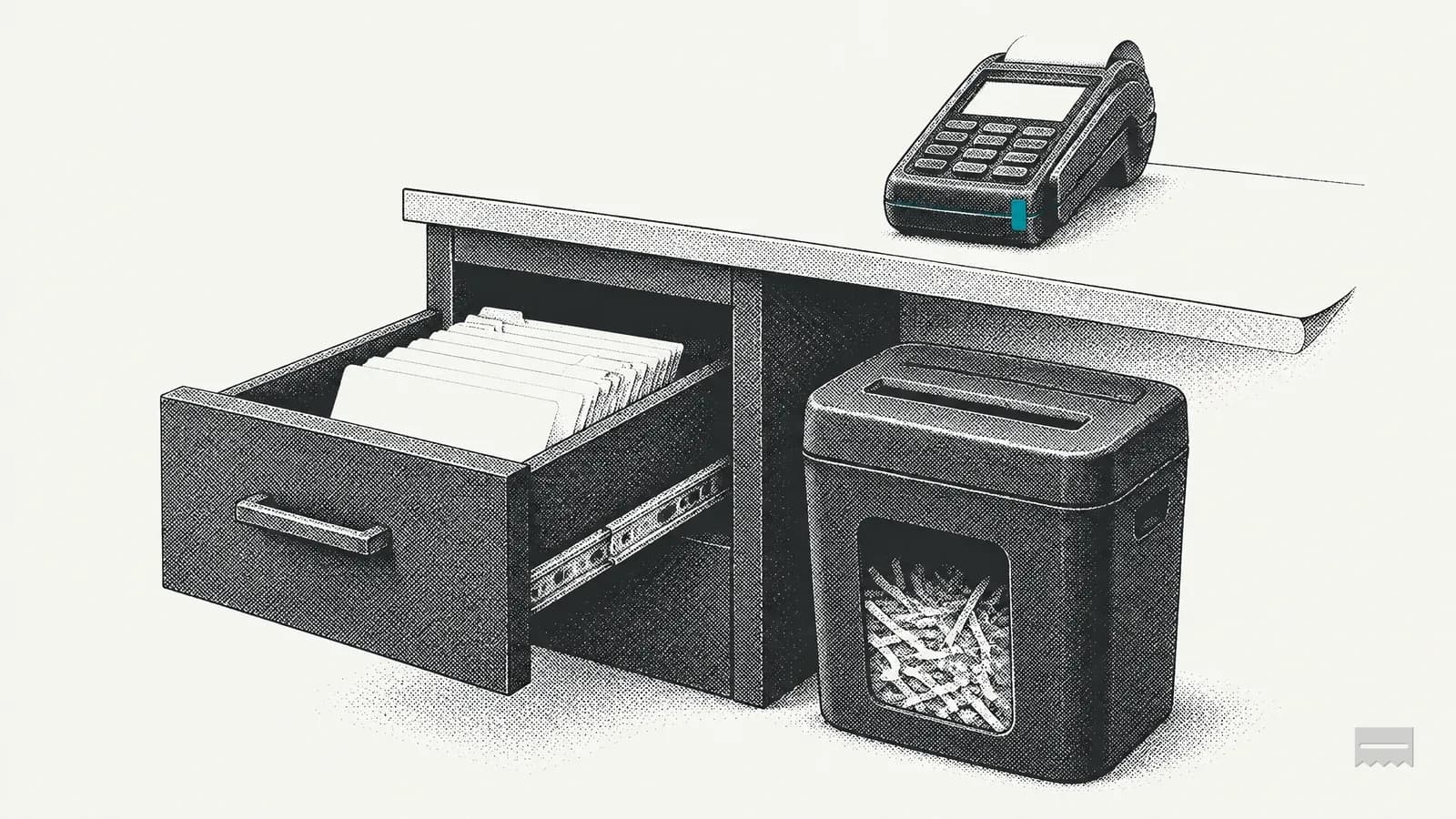
What you may keep, and what you may never keep
PCI DSS has a name for everything on a card. Account data is cardholder data and/or sensitive authentication data. PAN is the “primary account number,” the card number that identifies the issuer and the cardholder account. The Council's glossary says cardholder data “consists of the full PAN,” and may also carry the cardholder name, expiry date and service code. Sensitive authentication data is the rest: “Security-related information used to authenticate cardholders and/or authorize payment card transactions,” including card verification codes, full track data, PINs and PIN blocks.
Swipe sideways for every column
| On the card | Counts as | Keep it? | The rule |
|---|---|---|---|
| Card number (PAN) | Cardholder data | Only if needed | Unreadable wherever stored; masked to the BIN and last four when shownReq. 3.5.1, 3.4.1 |
| Cardholder name | Cardholder data | Only if needed | Stored securely, only as the business needs itReq. 3.3.1.1 note |
| Expiry date | Cardholder data | Only if needed | Stored securely, only as the business needs itReq. 3.3.1.1 note |
| Service code | Cardholder data | Only if needed | Stored securely, only as the business needs itReq. 3.3.1.1 note |
| Security code (CVV2, CVC2, CID) | Sensitive authentication data | Never | Gone once the charge is authorized, even if encryptedReq. 3.3.1.2 |
| Full track or chip data | Sensitive authentication data | Never | Not stored once authorization completesReq. 3.3.1.1 |
| PIN and PIN block | Sensitive authentication data | Never | Not stored, even if you encrypt the block againReq. 3.3.1.3 |
Source: PCI SSC Glossary: Cardholder Data, Sensitive Authentication Data, read on 2026-10-22
Source: PCI DSS v4.0.1 via the Prioritized Approach Tool, Req. 3.3.1.1–3.3.1.3, 3.4.1, 3.5.1, read on 2026-10-22
Cardholder data may be stored when the business needs it, and then it is protected. On the card number, name, expiry and service code, the standard says they “may need to be retained” and adds: “To minimize risk, store securely only these data elements as needed for business.” Sensitive authentication data has no such door. 3.3.1: “SAD is not stored after authorization, even if encrypted.” Sensitive authentication data covers the card verification code, full track data, PINs and PIN blocks.
The security code: take it, use it once, let it go
The card verification code is “the three- or four-digit value printed on the front or back of a payment card” (also called CVV2, CVC2, CID and other brand names). It slips into storage easily: a box on a signed form, a line in an order note.
“The card verification code is not stored upon completion of the authorization process.”
Source: PCI DSS v4.0.1 Req. 3.3.1.2, via the Prioritized Approach Tool, read on 2026-10-22
Asking for it is fine. The Council's FAQ 1280 says “PCI DSS does not prohibit the collection of card verification codes prior to authorization” of a specific purchase. Keeping it for later is not: card verification codes “are not needed for card-on-file or recurring transactions,” the FAQ's example being a recurring gym membership, and the same ban covers concierge-style services that hold a card to book restaurants or theatre tickets for a customer. A customer's written permission changes nothing: it “has no validity for PCI DSS.”
The security code, start to finish
Before the charge is authorizedMay be collected
FAQ 1280
Held electronically until thenEncrypted
Req. 3.3.2
Once the charge is authorizedUnrecoverable
Req. 3.3.1
Next month's recurring chargeNot needed
FAQ 1280
Kept after authorizationNever
Source: PCI SSC FAQ 1280, read on 2026-10-22
Source: PCI DSS v4.0.1 via the Prioritized Approach Tool, Req. 3.3.1, 3.3.2, read on 2026-10-22
If an order sits on a computer before it is charged, Requirement 3.3.2 says “SAD that is stored electronically prior to completion of authorization is encrypted using strong cryptography,” and whether you may hold it at all “is determined by the organizations that manage compliance programs (for example, payment brands and acquirers).” Phone lines are covered too. The Council's telephone guidance says: “If SAD is received and recorded, the entity MUST render all data unrecoverable upon completion of the authorization process.” That includes a call recording that caught a customer reading out the code.
Paper, phone notes and inboxes are storage too
Storage is not only a database. Asked whether PCI DSS covers paper, the Council's FAQ 1069 answers “Yes”: the requirements apply “if a Primary Account Number (PAN) is stored, processed, or transmitted on or by any media, including paper records,” and Requirement 9 covers “the safeguarding of physical media, including paper records.” The phone is no exception.
“…should the entity use an answering machine to capture customer account data or the person answering the call writes down the account data, then the collection of account data in the scenario would be considered ‘storage,’ and the entity's processes and environment would be considered in scope for PCI DSS.”
Source: PCI SSC telephone supplement v3.0, §2.3.1, p. 6, read on 2026-10-22
Paper you keep follows Requirement 9. “All media with cardholder data is physically secured” (9.4.1), and 9.4.6: paper with cardholder data is “cross-cut shredded, incinerated, or pulped” when no longer needed, and kept in secure storage containers until then. A drawer of signed forms is in scope for as long as the card numbers on it are readable.
Email and text spread further: a copy can sit on every device and server the message touched. Requirement 4.2.2 says “PAN is secured with strong cryptography whenever it is sent via end-user messaging technologies,” and the Council's phone guidance says plainly: “Never send CHD over an unencrypted, end-user messaging medium such as chat, social media, SMS (short message service)/text, or e-mail, or other non-encrypted communication channel.”
Find the card numbers you already hold
Card data piles up without anyone deciding to keep it: in an order pad, a voicemail box, a sent-mail folder, the memo field of an invoice. Tick every place yours has landed and the receipt lists the fix and the rule for each. If your books live in QuickBooks, the sweep for card numbers in QuickBooks memos, notes and attachments covers the places accounting software adds.
Clean-up receipt
Paper order forms or signed authorization formsPaper
Lock them away, then cross-cut shred, incinerate or pulp once the card is set up with your processor.
FAQ 1069; Req. 9.4.1, 9.4.6
Emails, texts or chats with a card numberElectronic
Delete the message and its copies, never reply with the number, and send a payment link instead.
Req. 4.2.2 and its note
Places to clean2
Electronic copies: SAQ D names “Merchants with electronic storage of account data.” Delete them and the shorter forms may fit again.
Once the list is clean, confirm what is still in scope with the PCI scope checker, then let the SAQ type finder tell you which questionnaire your channels now point to.
If you keep card numbers yourself
Some businesses still hold card numbers on purpose: old billing software, a customer file for phone orders. PCI DSS allows it, with conditions. The first is to keep less. Requirement 3.2.1 opens: “Account data storage is kept to a minimum through implementation of data retention and disposal policies, procedures, and processes” that cover every place it is stored.
The second is that what you keep cannot be read. 3.5.1: “PAN is rendered unreadable anywhere it is stored” by one-way hashes of the full PAN, truncation, index tokens, or strong cryptography with key management. “Anywhere” is meant literally: the requirement's note names “flat files such as text files spreadsheets” and non-primary storage such as “backup, audit logs, exception, or troubleshooting logs.”
Masking
“Method of concealing a segment of PAN when displayed or printed.” It is about what people see.
RuleReq. 3.4.1
Truncation
“Method of rendering a full PAN unreadable by removing a segment of PAN data.” It is about what is kept.
RuleReq. 3.5.1
Source: PCI SSC Glossary: Masking, Truncation, read on 2026-10-22
On masking, the standard is precise. 3.4.1: when PAN is displayed, “the BIN and last four digits are the maximum number of digits to be displayed” unless a person has a legitimate business need to see more. And the questionnaire changes with the storage. SAQ D for Merchants: “All merchants not included in descriptions for the above SAQ types.” Examples include “E-commerce merchants that accept account data on their website” and “Merchants with electronic storage of account data.”
What keeping card numbers commits you to
- 3.2.1A retention and disposal policy covering every place card data is stored, with a business reason and a time limit for each
- 3.2.1A check “at least once every three months” that data past its retention period has been securely deleted
- 3.5.1The card number unreadable in databases, spreadsheets, backups and logs alike
- 3.4.1Screens and printouts masked, with the full number shown only to people with a business need
- 9.4.7Old drives and devices destroyed, or the card data on them made unrecoverable
Questionnaire for stored card dataSAQ D
Source: PCI DSS v4.0.1 via the Prioritized Approach Tool, Req. 3.2.1, 3.4.1, 3.5.1, 9.4.7, read on 2026-10-22
Source: PCI SSC, SAQ Instructions and Guidelines v4.0.1 r1, pp. 5 and 23, read on 2026-10-22
Encrypting the file is allowed, and it brings key-management duties of its own; the tokenization vs encryption guide lays out what each does to your scope. The shorter road is to stop holding the number.
The better way: your processor keeps the card, you keep a token
“Tokenization is a process by which the primary account number (PAN) is replaced with a surrogate value called a ‘token.’ De-tokenization is the reverse process of redeeming a token for its associated PAN value.” When your processor does the tokenizing, the vault and the de-tokenizing sit on its side, and what lands in your customer records is a value you can charge but cannot read.
A card on file, the token way
- 01CustomerTypes the card into your processor's payment page, field or terminal, once.
- 02ProcessorKeeps the card number in its own vault and sends back a token.
- 03YouSave the token against the customer, with the signed card-on-file agreement.
- 04YouCharge again by sending the token. The card number never comes back to you.
Card numbers on your sideNone
Source: PCI SSC, Tokenization Guidelines, §1.3 and §2.4.1, read on 2026-10-22
Source: Visa stored-credential guide, p. 13, read on 2026-10-22
Tokens can shrink PCI scope, but “Tokenization solutions do not eliminate the need to maintain and validate PCI DSS compliance.” A system holding only tokens is out of scope only if the PAN cannot be recovered from those tokens and the system cannot affect cardholder data security. What stays yours is where the card is typed:
“Some PCI DSS requirements will apply to the merchant even when a tokenization solution is outsourced or hybrid. For example, PCI DSS controls apply wherever PAN is processed, stored, or transmitted—such as at the point of capture—as well as at any de-tokenization points.”
Source: PCI SSC, Tokenization Guidelines, §2.4.1, p. 14, read on 2026-10-22
So the choice of payment page still decides your questionnaire. SAQ A is for “Card-not-present merchants (e-commerce or mail/telephone-order) that completely outsource all account data functions to PCI DSS validated and compliant third parties. No electronic storage, processing, or transmission of account data on their systems or premises.” And the provider's status is not yours: “The use of a PCI DSS compliant TPSP does not make an entity PCI DSS compliant, nor does it remove the entity's responsibility for its own PCI DSS compliance.” (Requirement 12.8.1, applicability notes.)
The card brands still treat a saved token as a saved card. Visa defines a stored credential as information “(including, but not limited to, an account number or payment token)” stored to process future purchases, and before storing one the merchant “must establish an agreement with the cardholder.” The recurring version of our card authorization form generator prints the lines Visa lists, with only the last four digits on the page you keep.
Quick reference: card storage on one receipt
Never keep after authorization
Security code, even for recurring charges3.3.1.2
Full track or chip data3.3.1.1
PIN or PIN block3.3.1.3
Keep only if needed, then protect
Card number, unreadable when stored3.5.1
BIN and last four at most on screen3.4.1
A reason and an end date for each3.2.1
Counts as storage
Paper forms and receipts with the numberFAQ 1069
A number written down on a call§2.3.1
A card number in email or text4.2.2
Best place for a card numberThe processor's vault
Source: PCI DSS v4.0.1 via the Prioritized Approach Tool, read on 2026-10-22
Source: PCI SSC FAQ 1069 and FAQ 1280; telephone supplement v3.0, read on 2026-10-22
Next step: the guide to every SAQ type shows which questionnaire your setup leads to once the stored cards are gone, and the rest of this topic sits under Payments & Card Data.
Sources
- PCI SSC: Prioritized Approach Tool for PCI DSS v4.0.1 (requirement text for 3.2.1, 3.3.1, 3.3.1.1–3.3.1.3, 3.3.2, 3.4.1, 3.5.1, 4.2.2, 9.4.1, 9.4.6, 9.4.7, 12.8.1) (docs-prv.pcisecuritystandards.org), read on 2026-10-22
- PCI SSC FAQ 1280: Can card verification codes be stored for card-on-file or recurring transactions? (pcisecuritystandards.org), read on 2026-10-22
- PCI SSC FAQ 1069: Does PCI DSS apply to paper with cardholder data? (pcisecuritystandards.org), read on 2026-10-22
- PCI SSC Information Supplement: Protecting Telephone-Based Payment Card Data, v3.0 (November 2018), sections 2.3.1, 4 and 5.2.1 (docs-prv.pcisecuritystandards.org), read on 2026-10-22
- PCI SSC Glossary (Account Data, Cardholder Data, Sensitive Authentication Data, Card Verification Code, Masking, Truncation, Media) (pcisecuritystandards.org), read on 2026-10-22
- PCI SSC: Information Supplement, PCI DSS Tokenization Guidelines (August 2011) (listings.pcisecuritystandards.org), read on 2026-10-22
- PCI SSC: SAQ Instructions and Guidelines, PCI DSS v4.0.1 r1 (April 2025) (docs-prv.pcisecuritystandards.org), read on 2026-10-22
- Visa: Improving Authorization Management for Transactions with Stored Credentials (2017) (usa.visa.com), read on 2026-10-22